The capital's three gates
Working design. New events, appearances, mechanics, and political details remain proposals. See canon ledger.
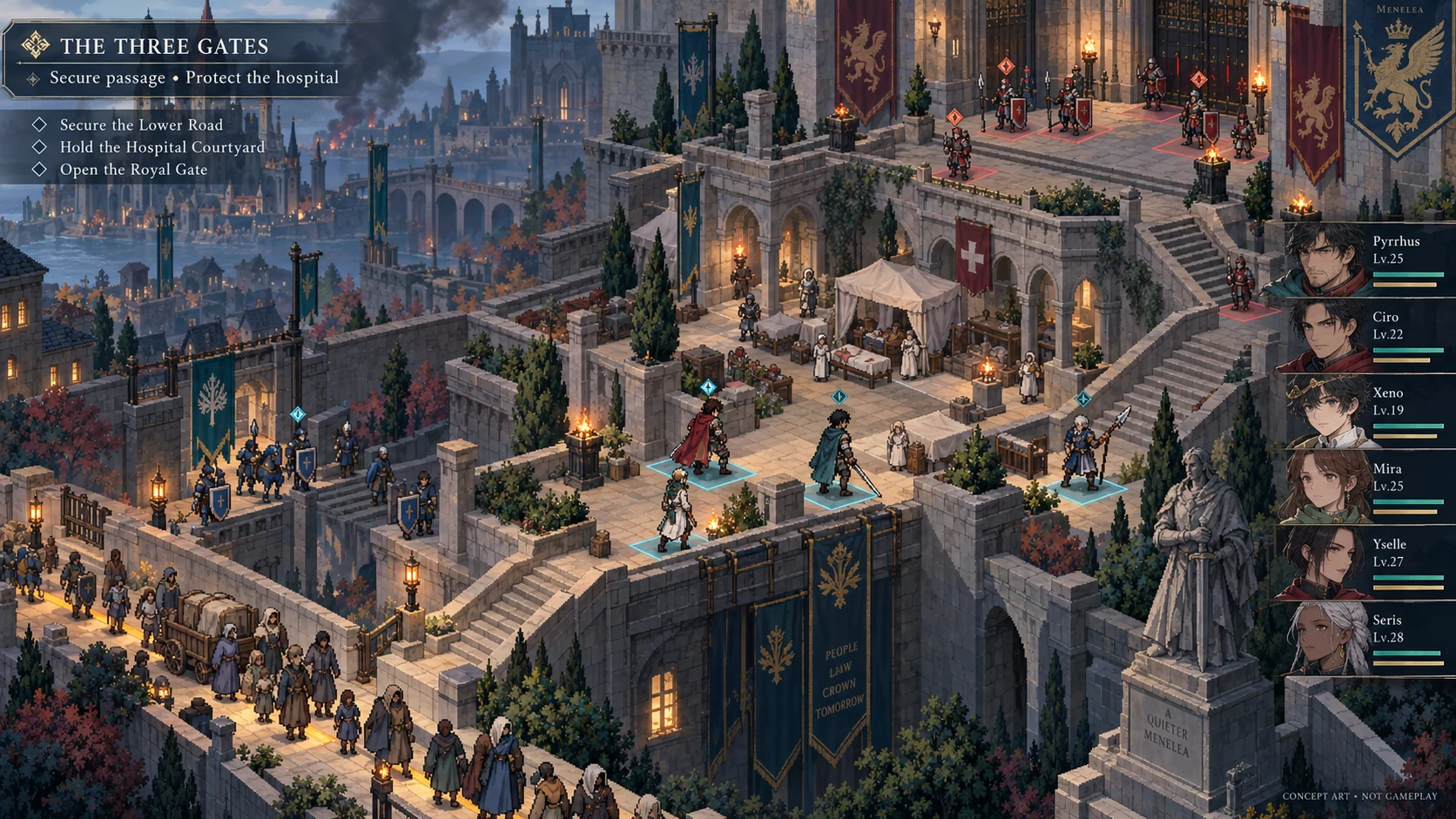
The capital is a living city, not a villain's fortress. Its districts contain people who fear the coalition, depend on palace wages, and remember provincial raids. The assault offers three connected approaches: a military gate held by Halbrecht's veterans, a river gate tied to food distribution, and a civic gate whose militia might negotiate. Earlier diplomacy, supply work, and public disclosures determine which options are credible.
Pyrrhus's traveling company handles a critical tactical objective while allied forces carry out orders elsewhere. The player chooses commanders and acceptable risks before entering battle. This is where the game demonstrates why the territory layer matters: a trusted governor may keep a rear province stable, a well-supplied army can accept surrender, and a neglected force may loot even after an otherwise clean tactical victory.
Xeno can address the civic militia, but his name alone is insufficient. He must offer specific guarantees: continued pay, protection from reprisals, and recognition of local representatives. Ciro confronts former comrades at the military gate. He can offer a chain of command that includes surrender procedures rather than demand personal loyalty. Pyrrhus decides whether to spend time opening relief routes while the palace strengthens its defenses.
The city changes as the battle progresses. Civilians move toward secured courtyards. Fires spread along identifiable paths. Gates opened through negotiation remain distinguishable from walls breached by force. Winning quickly may preserve the army while worsening civilian losses. A slower assault is not automatically kinder if supplies are exhausted. The player sees the consequences of preparation, restraint, and desperation together.
Source document: 06-expanded-storyline.md