Mira Fen — Love that survives being needed
Working design. New events, appearances, mechanics, and political details remain proposals. See canon ledger.
Mira knew Pyrrhus before he had a public name worth exploiting. That history gives her access to his humor and vulnerabilities, but it also creates a danger: both can assume familiarity means they already understand each other. She returns from surgical training with convictions he has not seen tested. He has become accustomed to making decisions quickly and being obeyed. Their early affection includes friction over how often he treats endurance as a substitute for rest.
Her first major bond scene follows Cinderford. Pyrrhus helps wash linens after a battle, expecting a private conversation. Mira gives him a task and continues working. Only later does she admit that she was angry when he promised the council she could establish a hospital without asking her. He thought he was recognizing her ability. She heard him assigning her the work that would make his promise possible. An apology requires changing how he consults her, not selecting a tender line and receiving affection.
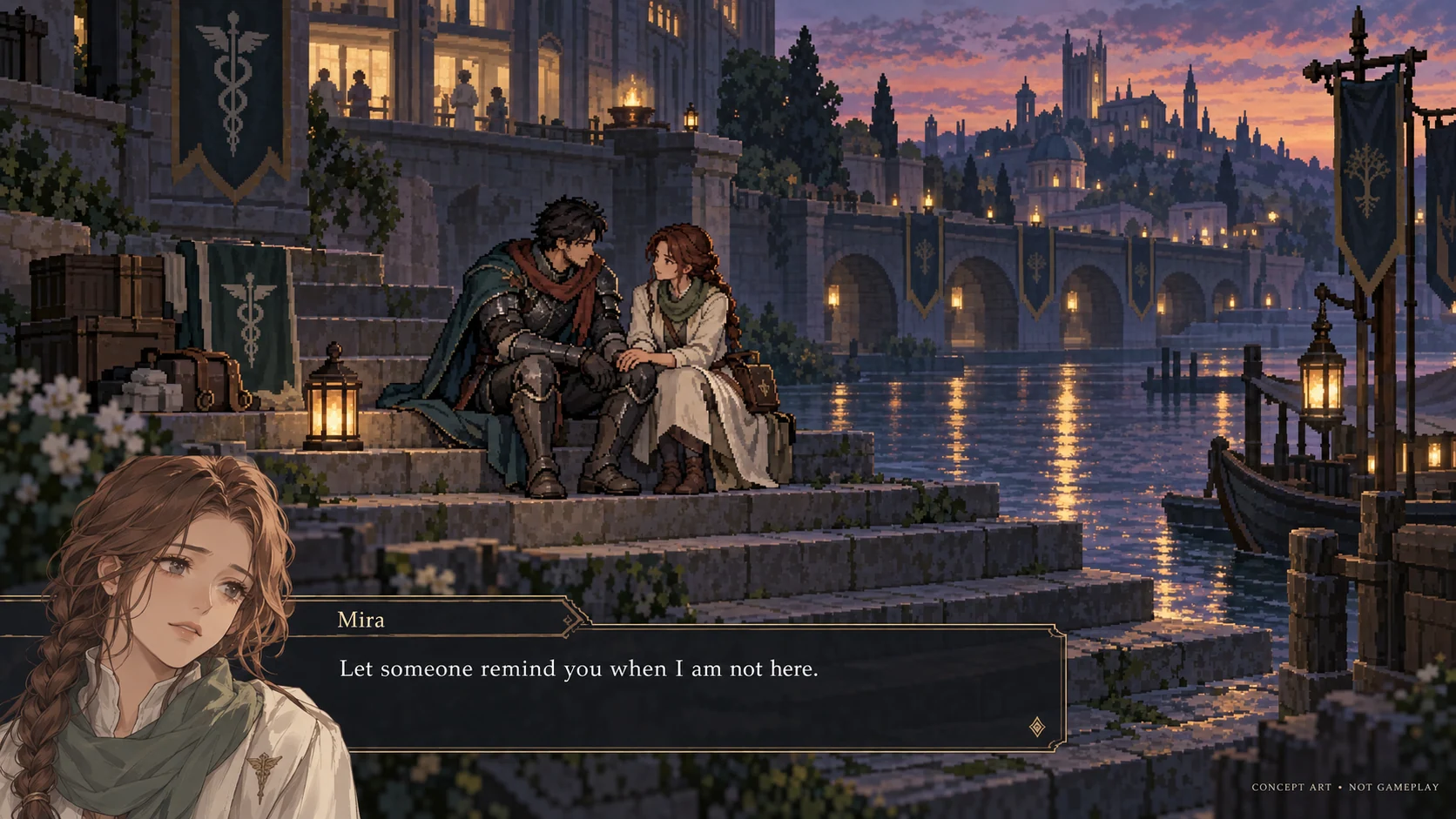
At the river steps, she speaks about a patient she could not save and another she chose not to operate on because the supplies were needed elsewhere. Pyrrhus cannot rescue her from the memory. He can listen without converting it into a lesson about his own burdens. This is the first romantic scene: quiet company, a shared cloak if invited, and permission to stop speaking. A kiss can occur here, but the scene should work equally well as deep friendship.
The route's central conflict comes with the hospital wagons. Mira insists that enemy wounded receive care under the same triage standards. An allied commander threatens to withdraw support. Pyrrhus can defend the policy, negotiate resources while preserving it, or override it for military advantage. Supporting her is not merely purchasing romance; it commits the coalition to a costly public principle. If he repeatedly uses her compassion as a resource while denying her authority, she ends the relationship and may still remain as an independent medical partner.
Her later confession is direct: she loves him, but she will not build a life around waiting for the next occasion on which he almost dies to prove he is useful. She asks for shared decisions about home, travel, and work. The mature resolution is neither her abandoning medicine nor Pyrrhus promising never to fight again. They make a practical arrangement that can survive duties to other people.
In a hopeful epilogue, they establish a network of field stations with local staff. Their own home is modest and occasionally noisy with visitors. Mira catches Pyrrhus trying to repair something he should have asked for help with. The final exchange can be playful because the relationship has earned relief from constant crisis. In a darker political ending, she may love him and refuse to live at his court. That separation should be treated as a serious outcome, not a punishment inflicted by a romance meter.
Source document: 06-expanded-storyline.md